III · Chant — Track 09
Fàire an uisge
The Vigil of the Water
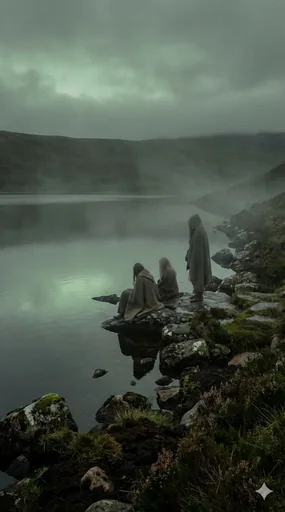
Beside still water, the clan keeps a vow without words. Nothing is spoken, nothing is revealed. The vigil holds, as it always has.
Gàidhlig
[Rann 1] Tha an t-uisge sàmhach romhainn, Gun ghuth, gun chomharra; Tha an oidhche na seasamh, 'S tha ar cridhe dùinte. Chan eil ceist anns an dorchadas, Chan eil freagairt air a sireadh; Tha sinn an seo, Agus fanaidh sinn. [Rann 2] Tha còmhdach air ar faclan, Tha sàmhchair air ar beul; Chan eil ainm air an nì seo, Chan eil e air a ghairm. Chan eil sinn ga thogail, Chan eil sinn ga bhriseadh; Tha e air a chumail fo'n uisge, Far nach ruig an solas. [Faire] Tha sinn nar suidhe ri taobh an uisge, Gun ghluasad, Gun ghuth. Tha an t-uisge a' cumail na tha fon uachdar, Gun fhacal, Gun bhrath. Tha an ùine a' dol seachad oirnn, Ach fanaidh an faire, Mar a tha i. [Deireadh] Chan eil gairm air a dhèanamh. Chan eil gealladh air a ràdh. Tha an t-uisge fhathast romhainn. Tha sinn fhathast an seo. Agus bidh sinn mar sin.
English
[Verse 1] The water is silent before us, without voice, without sign; the night stands still, and our heart is closed. There is no question in the darkness, no answer is sought; we are here, and we will remain. [Verse 2] There is a covering over our words, there is silence upon our mouth; there is no name for this thing, it is not called. We do not lift it, we do not break it; it is kept beneath the water, where the light does not reach. [Vigil] We sit beside the water, without movement, without voice. The water holds what lies beneath the surface, without word, without betrayal. Time passes over us, but the vigil remains, as it is. [Ending] No call is made. No promise is spoken. The water is still before us. We are still here. And so we will be.
In the cycle
Intro / summary
A chant of water, waiting, and suspended protection. After wind-vision and unstable perception, the cycle lowers itself into a slower, deeper state, where the clan does not seek revelation but keeps watch. Water becomes the medium of listening, and protection becomes an act of patient attention.
What this composition is
This composition is a vigil rather than a declaration. It belongs to the water rites of the clan and is tied to times of danger, storm, and uncertainty, especially where the sea or the loch threatens to exceed human measure. Unlike the march or the oath, it does not gather the clan into a single outward gesture. It gathers the clan inward, into steadiness.
In the ritual material, Fàire an uisge is defined as a prayer in times of storm, associated with Loch na Fala and with the offering of water back into the earth. Its musical atmosphere is slow, fluid, and meditative, without percussive assertion.
What it represents
This composition represents protection through watching. The clan does not always survive by acting. Sometimes it survives by holding position, listening, and refusing panic. That is the ethical and symbolic posture of the vigil.
Its place in the cycle is therefore very precise. After the visionary instability of The Night of the Winged Spirits, the work does not move toward explanation. It moves toward composure. The chant teaches that what has been sensed in wind and darkness must now be held, not interpreted too quickly.
Ritual frame
- Function
- storm prayer, suspended protection, attentive endurance
- Ritual role
- vigil in times of danger upon or beneath water
- Place
- Loch na Fala
- Element
- water
- Dominant voice
- low female lead with low male echo
- Atmosphere
- liquid, solemn, hypnotic, restrained
- Cycle position
- C8
Symbolic meaning
This composition draws the Dragon into relation with water as memory-bearing depth. In the sacred geography of the clan, Loch na Fala is not simply a location, but a site of blessing, passage, reflection, and submerged light. The lore repeatedly associates it with green presence beneath the surface, especially at night or under altered atmospheric conditions.
Water here does not function as cleansing in a generic sense. It is older and heavier than that. It preserves, receives, reflects, and conceals. The vigil honours that density. The Dragon is not summoned out of the water. The chant acknowledges that the water may already be carrying its silence.
Listening note
This piece should be heard without urgency. It works by depth rather than momentum. Let the long vowels, the slowed phrasing, and the sense of submerged resonance do the work.
Text note
The extended song documentation describes Fàire an uisge as a slow, liquid vigil hymn, led by a low female voice with a low male echo, structured as a prayer for protection during maritime or weather-bound danger. The ritual frame and place attachment are fully coherent with the clan’s sacred geography.
Place in the saga
The visionary wind of the previous chant gives way here to stillness and watchfulness. The cycle descends from air into water.
From here, the next movement turns outward again, toward warning, cliff, and communal call.