III · Chant — Track 08
Oidhche nan eòin
The Night of the Winged Spirits
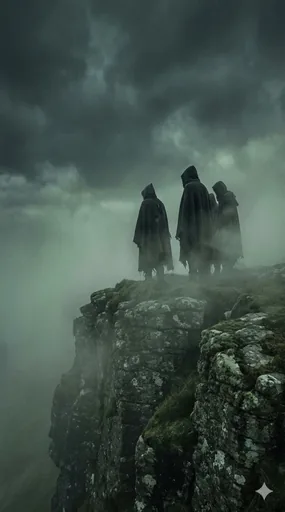
On the wind-torn cliffs of Creagan nan Sìth, the clan keeps vigil. Breath, silence, and unseen presences pass through the night. Nothing is shown. Everything is listened to.
Gàidhlig
[Rann 1] Tha a' ghaoth os cionn nan creag, Gun ainm, gun ghairm; Tha an oidhche fosgailte, 'S tha ar n-anail sàmhach. [Rann 2] Tha gluasad anns an adhar, Gun chorp, gun sgàil; Tha fuaim os cionn nan cinn, Mar sgiath air a' ghaoth. Chan eil iad a' tighinn don talamh, Chan eil iad a' bruidhinn rinn; Tha iad a' dol seachad, 'S tha an oidhche gan giùlan. [Cearcall na Gaoithe] A' ghaoth a' dol. A' ghaoth a' tilleadh. Os ar cinn. Os ar n-anail. Gun lorg air a' chreig. Gun lorg air an talamh. A' tighinn. A' falbh. Tha an èadhar beò. Tha an oidhche a' gluasad. [Faire na h-Oidhche] Tha sinn nar seasamh. Gun ghluasad. Gun ghuth. Tha a' ghaoth fhathast os ar cionn. Chan eil i gar gairm. Chan eil i gar fàgail. Tha an oidhche fosgailte. Tha na creagan ag èisteachd. Agus èistidh sinn fhìn.
English
[Verse 1] The wind is above the cliffs, without name, without call; the night is open, and our breath is silent. [Verse 2] There is movement in the air, without body, without shadow; there is a sound above our heads, like a wing in the wind. They do not come to the ground, they do not speak to us; they pass by, and the night carries them. [Circle of the Wind] The wind goes. The wind returns. Above our heads. Above our breath. No trace on the rock. No trace on the ground. Coming. Leaving. The air is alive. The night moves. [Night Vigil] We stand. Without movement. Without voice. The wind is still above us. It does not call us. It does not leave us. The night remains open. The cliffs are listening. And we too will listen.
In the cycle
Intro / summary
A visionary rite of wind and ancestral passage. In this composition, the clan enters a night of unstable perception, where shapes cross the air like fragments of memory. Nothing is shown plainly. The Dragon does not appear. But the world begins to feel inhabited by moving traces older than the living.
What this composition is
This is one of the most visionary chants of the expanded cycle. It is associated with a rite of ancestral contact in a night of powerful wind, where green wing-like presences are sensed crossing the air. The project documents are careful here: these are not birds in an ordinary sense, and not literal fantasy beings. They are fragments of memory carried through the atmosphere.
That distinction matters. This composition does not present spirits as characters. It presents the night as a condition in which ancestral passage becomes perceptible through breath, sound, and unstable form.
What it represents
This composition represents vision through the wind. The clan does not command revelation. It remains exposed to it. The rite belongs to a moment when memory ceases to be only internal or spoken and becomes atmospheric, moving through air as if the world itself were trying to remember.
Its place in the cycle is therefore precise. After flame, light, and renewed lament, the saga enters a state of visionary opening, where the boundary between perception and inheritance becomes thinner.
Ritual frame
- Function
- contact with ancestors, wind-borne vision, suspended awareness
- Ritual role
- night rite of transition and ancestral passage
- Place
- Creagan nan Sìth, the spirit-cliffs of Caithness
- Element
- wind
- Dominant voice
- male lead moving toward female response and distant chorus
- Atmosphere
- spectral, suspended, trance-like
- Cycle position
- C7
Symbolic meaning
This chant stands at the edge between the Dragon’s light-form and voice-form, but it is driven above all by wind. The lore identifies wind as one of the Dragon’s principal carriers, the medium by which memory, warning, and ancestral resonance move across cliff, sea, and night. Here the Dragon is not depicted. It is felt in the way air itself becomes inhabited.
The winged forms are therefore not creatures to visualise too directly. They belong to the saga’s law of indirection: the observer should sense more than they see.
Listening note
This piece should be heard as a thinning of certainty. It works best when the listener allows atmosphere, breath, and suspended sound to carry meaning without demanding explicit explanation.
Text note
The extended song documents define this composition as visionary, whispered, and trance-like, built around the idea that the Dragon speaks through the wind. The chant’s atmosphere is explicitly described as ancestral, spectral, and suspended, with breath and storm resonance taking precedence over melody in the usual sense.
Place in the saga
The cycle has moved from protection to vow, from memory to flame, from light to renewed lament. Now it enters a night of perception altered by wind.
From here, the next movement turns toward water, listening, and suspended protection.