III · Chant — Track 10
Gairm nan Creag
The Call of the Cliffs
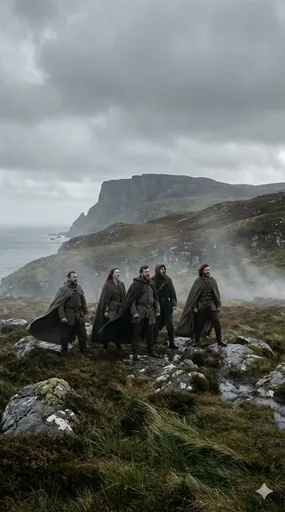
When danger nears, the clan does not sing. It calls. Voices strike stone and wind, carrying a warning across the cliffs. This is the gairm — harsh, necessary, and held together.
Gàidhlig
[Guth nam fear – Rann 1] Tha sinn nar seasamh air na creagan, An aghaidh na gaoithe; Tha ar casan daingeann, Tha ar sùilean fosgailte. Chan eil cadal san fhearann, Chan eil sìth anns an adhar; Tha rudeigin a' tighinn, Agus tha fios againn. [Guth nam fear – Rann 2] Tha an creag a' cluinntinn ar guth, Tha an ghaoith ga giùlan; Chan eil sinn ag iarraidh blàr, Ach chan eil sinn a' teicheadh. Tha an gairm air a thogail, Chan ann airson eagal, Ach airson cuimhne, Agus airson aonachd. [Gairm nan creag – guthan uile] Gairm! Gairm ris na creagan! Gairm! Gairm ris a' chinneadh! Gairm! Tha sinn an seo! Gairm! Agus cluinnidh iad! [Guth nam ban – Freagairt nan cnoc] Tha sinn gad chluinntinn! Tha sinn gad chluinntinn! Bhon chreig, Bhon ghaoth! [Deireadh] Tha an gairm air a dhèanamh. Tha an fhuaim air falbh. Tha a' ghaoth a' tilleadh. Agus fanaidh sinn.
English
[Verse 1] We stand upon the cliffs, against the wind; our feet are firm, our eyes are open. There is no sleep in the land, no peace in the air; something is coming, and we know it. [Verse 2] The rock hears our voice, the wind carries it; we do not seek battle, but we do not flee. The call is raised, not for fear, but for memory, and for unity. [Call of the cliffs] Call! Call to the cliffs! Call! Call to the kin! Call! We are here! Call! And they will hear! [Answer of the hills] We hear you! We hear you! From the rock, From the wind! [Ending] The call has been made. The sound is gone. The wind returns. And we remain.
In the cycle
Intro / summary
A chant of warning, cliff, and collective alert. After the inward steadiness of the water vigil, the cycle rises again into exposed air and hard stone. This is the moment in which the clan calls across distance, not in panic, but in disciplined readiness.
What this composition is
This composition is the ritual call issued when danger approaches. It belongs to exposed ground, to promontories, cliffs, and windswept heights, where voice must travel across distance and where warning becomes a communal act. It is not a battle song in the modern sense. It is an auditory form of unity under threat.
The project’s extended materials define Gairm nan Creag as a harsh, slow call ritual, associated with Fitful Head and with the raw, open-throat force of a clan warning carried by wind and stone. It is built not around melody in the lyrical sense, but around breath, cry, and collective force.
What it represents
This composition represents unity through alarm. The clan does not become itself only in peace, or only in grief, or only in sacred vow. It also becomes itself in the act of warning one another. Readiness is part of kinship.
That is why the composition matters so much structurally. It prevents the cycle from settling into contemplation alone. The work remembers that land, ancestry, and ritual all exist within danger, weather, exposure, and the need for response.
Ritual frame
- Function
- warning, gathering under threat, communal readiness
- Ritual role
- cliff-call of the northern heights
- Place
- Fitful Head
- Element
- wind and rock
- Dominant voice
- male-led call with sharp female answering echo
- Atmosphere
- harsh, raw, forceful, exposed
- Cycle position
- C9
Symbolic meaning
This chant belongs strongly to the Dragon’s voice-form, but in one of its hardest manifestations. The mythos teaches that the Dragon’s voice may be heard not only in keening or ancestral reply, but in the wind’s answering force, in vocalised air, in resonance thrown against stone. Here voice is not intimate. It is public, urgent, and cliff-bound.
This is important: the Dragon does not issue the warning as a separate being. The warning exists within the Dragon’s field of presence, and the clan gives it sound. The chant therefore sits exactly at the meeting point of land, danger, and disciplined community.
Listening note
This piece should be heard as a call cast into open air. Its force is less about ornament than about projection, breath-pressure, and the sense of many bodies becoming one signal.
Text note
The extended project files define Gairm nan Creag as a ritual warning chant, with male open-throat invocation and answering female cliff-echo, built from stillness toward a thunderous call of unity before fading back into wind. The places-of-power file also links this rite directly to the spirit-cliffs and the sounding geography of the northern landscape.
Place in the saga
Water taught the clan to hold still. The Call of the Cliffs teaches it how to sound across danger.
From here, the cycle turns toward elder memory, transmission, and the binding of stories.