III · Chant — Track 07
An Caoineadh Uaine
The Green Keening
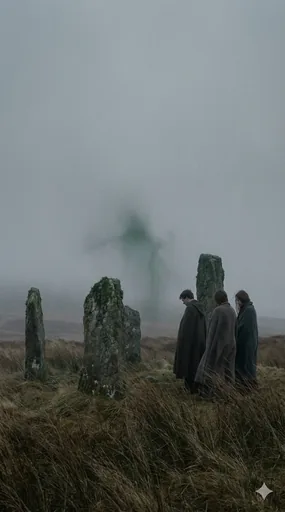
In 'The Green Keening', grief is not resolved but endured. The clan remains under wind and stone, while the Green Dragon stays unseen, guarding in silence.
Gàidhlig
[Rann 1] Tha'n talamh fuar fo ar casan, 'S a' ghaoth a' giùlan ainm nach till; Tha na clachan fhathast ag èisteachd, Ged dh'fhalbh na guthan bhàrr a' chnuic. [Rann 2] Càit' a bheil na làmhan a sheas còmhla rinn? Càit' a bheil na sùilean a chunnaic an latha? Dh'fhalbh iad leis a' cheò 's leis an uisge, Gun fhacal fàgail, gun ghealladh air ais. [Caoineadh] O… a dh'fhalbh… O… fon ùir fhuar… O… anail na h-oidhche… Gun solas. Gun fhacal. Gun aisig. O… a' ghaoth air na clachan… O… cuimhne nach freagair… [Rann 3] Chan eil an Dhragaín dall, Chan eil e bodhar ris a' ghaoth. Tha e a' faicinn fon cheò 's fon dorchadas, Tha e ag èisteachd ris a' chaoineadh gun fhreagairt. Chan eil e a' togail na mairbh, Chan eil e a' glanadh na fola, Ach tha e a' cumail na crìche, 'S a' cumail ar n-anail beò. [Deireadh] Fanaidh sinn. Fo'n speur fhuar. Leis a' ghaoth gar bualadh. Fanaidh an talamh. Fanaidh na clachan. Fanaidh an cuimhne. Agus fanaidh an Dhragaín, Os ar cionn, Gun fhacal, Gun fhàgail.
English
[Verse 1] The ground is cold beneath our feet, and the wind carries a name that will not return; the stones are still listening, though the voices have gone from the top of the hill. [Verse 2] Where are the hands that stood with us? Where are the eyes that saw the day? They left with the mist and with the rain, without a word of departure, without a promise of return. [Keening] Oh… what has gone… Oh… beneath the cold earth… Oh… breath of the night… No light. No word. No return. Oh… the wind on the stones… Oh… memory that does not answer… [Verse 3] The Dragon is not blind, it is not deaf to the wind. It sees beneath mist and darkness, it listens to the keening without reply. It does not raise the dead, it does not wash away the blood, but it holds the boundary, and keeps our breath alive. [Ending] We remain. Under the cold sky. With the wind striking us. The land remains. The stones remain. Memory remains. And the Dragon remains, above us, without a word, without leaving.
In the cycle
Intro / summary
A return of lament under altered conditions. This composition does not repeat the founding keening. It carries grief into a new tonal field, where sorrow and radiance coexist. The clan does not leave mourning behind, but learns to hear it in changed light.
What this composition is
This composition is a transformed lament. It belongs to the middle expansion of the cycle, after the movement into flame and light, and it reintroduces grief without returning to the exact ritual gravity of the founding keening.
In structural terms, this matters enormously. The cycle is not a sequence of sealed compartments. Memory is not finished once named, and grief does not disappear once sung. The Green Keening shows that sorrow can return in another register, one touched by illumination, endurance, and ritual maturity.
What it represents
This composition represents grief after renewal. It is the recognition that the clan’s relationship to mourning changes over time, but is never dissolved. Earlier lament was foundational. This lament is recursive. It comes after rekindling, and therefore carries a different burden.
The key symbolic movement is not from darkness to joy, but from darkness to a sorrow that can coexist with light. That is why this composition belongs exactly where it does in the cycle. It prevents the middle section from becoming falsely triumphant.
Ritual frame
- Function
- renewed lament, memory under changed light
- Ritual role
- secondary or transformed keening within the expanded cycle
- Place
- not fixed in the older documents as a separate rite, but spiritually continuous with the memory-sites of the clan
- Element
- breath, memory, muted light
- Dominant voice
- likely alternating or layered vocal structure, depending on final compositional form
- Atmosphere
- sorrowful, lucid, restrained, enduring
- Cycle position
- C6
Symbolic meaning
This composition stands at the crossing between the Dragon’s light-form and voice-form. Light remains present, but no longer as rekindling alone. Instead, it falls across memory and reveals that not all continuity is consoling. The Dragon here is not comfort. It is the condition in which grief can remain meaningful.
That makes this chant especially important in the logic of the saga. It refuses both erasure and spectacle. It lets memory remain alive under altered conditions, which is one of the deepest moral instincts of the entire project.
Listening note
This piece should be heard with patience and without expectation of release. It is not a second version of the first keening. It is what lament becomes once the clan has already passed through fire and light.
Text note
The title belongs to the published structure of the expanded cycle, and while earlier internal documents do not isolate this exact composition under the same name, its function is fully consistent with the project’s established ritual logic: continuity of memory, persistence of lament, and refusal of narrative simplification. The composition should therefore be read as a canonical deepening, not as a contradiction.
Place in the saga
Light does not cancel grief. Renewal does not abolish memory. The Green Keening ensures that the cycle remains ethically intact.
From here, the saga passes into wind-vision and unstable perception.