III · Chant — Track 06
Solas an Dhragain
The Light of the Dragon
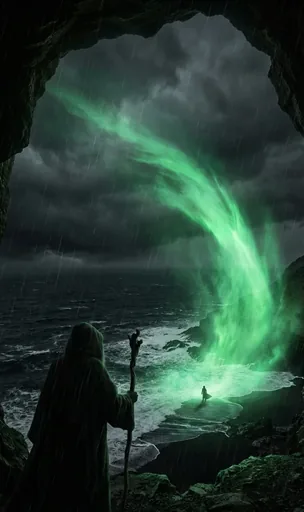
In ‘The Light of the Dragon,’ an elder recounts a night 500 years earlier, when a green radiance rose over the waves and a gentle breath revealed a guardian, not a beast.
Gàidhlig
[Rann 1] Ro linn ar sinnsearan, fada ron chogadh is an acras, Nuair nach robh ach dorchadas air na h-eileanan cruaidh, Dh'èirich solas uaine os cionn nan tonn dorcha, Is stad na gaoithe mar gum biodh an saoghal ag èisteachd. [Rann 2] Chunnaic fear a-mhàin an cumadh anns a' cheò, Chan e nathair dhubh, chan e beathach fiadhaich, Ach dragan de sholas, a' cromadh a chinn thar a' chladaich, A' coimhead sìos air a' chinneadh gun fhearg, gun fheòil san t-sùil. [Rann 3] An oidhche sin cha do loisg e baile, Cha do dh'fhàg e cnàmh briste no fuil air an tràigh, An àite teine is sgrios, thug e blàths dhan t-sluagh, Is shuidh iad timcheall na ciad-theine le cridheachan fosgailte. [Cor] Oidhche na ciad-theine, oidhche an Dhragaín Uaine, Far nach d'thàinig e mar nàimhdean nan sgeulachdan cèin, Ach mar sgiath uaine os ar cionn, mar sholas os cionn ar cinn, 'Na chompanach dìleas air feadh linntean cruaidh. [Rann 4] O bho sin air adhart, tro linntean an teine is na geamhraidhean, Cha robh an dragan na uabhas do chloinn nan creag, B' e an comharra gun robh an talamh fhathast nar taobh, Is gun robh cuimhne na h-eileanan beò anns an anail uaine. [Rann 5] Mar sin an-diugh, nuair chì sinn an ceò uaine aig an loch, Chan eil sinn a' crith le eagal nan seann sgeul, Ach a' seasamh nas dlùithe ri chèile mar chinneadh aon-fhuil, A' cur ar n-earbsa anns an neach-dìon nach loisg ar taigh gu bràth. [Cor deireannach] Oidhche na ciad-theine, cuimhnichidh sinn an-còmhnaidh, Chan e beathach craosach ach caraidean nar n-oidhche, An Dhragaín Uaine os ar cionn mar sgàil de sholas, A' stiùireadh ar clann tro na linntean fiadhaich.
English
[Verse 1] Before the time of our ancestors, long before war and hunger, when there was only darkness over the hard islands, a green light rose above the dark waves, and the wind stopped as if the world were listening. [Verse 2] One man alone saw the shape in the mist, not a black serpent, not a wild beast, but a dragon of light, bending its head over the shore, looking down on the people without anger, without hunger in its eye. [Verse 3] That night it did not burn a village, it left no broken bone and no blood on the shore. Instead of fire and destruction, it gave warmth to the people, and they sat around the first flame with open hearts. [Chorus] Night of the first flame, night of the Green Dragon, when it did not come as the enemies of foreign tales, but as a green shield above us, as a light over our heads, a faithful companion through harsh ages. [Verse 4] From that time onward, through ages of fire and winters, the dragon was no terror to the children of the cliffs. It was the sign that the land was still on our side, and that the memory of the islands lived on in the green breath. [Verse 5] So today, when we see the green mist by the loch, we do not tremble with fear of the old tales, but stand closer together as a clan of one blood, placing our trust in the guardian who will never burn our home. [Final Chorus] Night of the first flame, we will always remember: not a ravenous creature, but friends in our night. The Green Dragon above us like a shadow of light, guiding our children through the wild ages.
In the cycle
Intro / summary
A chant of manifestation through radiance. This is not the appearance of a creature, but the recognition of a presence through light. The cycle passes here into a more exposed and visionary state, where illumination does not explain the Dragon, but makes its proximity more difficult to ignore.
What this composition is
This composition belongs to the central luminous zone of the saga. If The First Flame is the ritual act by which the clan rekindles itself, The Light of the Dragon is the chant in which that rekindled state becomes perceptible in the world around it.
This is not a narrative revelation scene. The Dragon does not arrive as an actor. Rather, the land appears altered by a quality of light that cannot be reduced to weather, but also cannot be separated from it. The composition holds that ambiguity as a sacred condition.
What it represents
This composition represents recognition through illumination. The clan does not receive an answer in words, nor a sign in the crude sense. Instead, it inhabits a field in which light itself becomes charged with memory, protection, and ancestral continuity.
Its role in the cycle is therefore transitional but crucial. The chant does not close the distance between human and Dragon. It makes that distance glow. It teaches the listener that some forms of revelation are not declarative. They are environmental.
Ritual frame
- Function
- luminous recognition, sacred perception, atmospheric revelation
- Ritual role
- chant of light-form awareness
- Place
- not fixed to one ritual site, but aligned with exposed land, water, and open sky
- Element
- light, mist, reflective atmosphere
- Dominant voice
- restrained solo or narrow communal texture, depending on final musical treatment
- Atmosphere
- clear, watchful, altered, quietly radiant
- Cycle position
- C5
Symbolic meaning
This composition belongs fully to the Dragon’s light-form, the mode in which the Green Dragon is perceived as green-gold shimmer, bioluminescent presence, or luminous field above sea, loch, mist, or stone. The mythos identifies this form with protection, prosperity, and the sense that the land itself is answering without speech.
What matters here is that light is not treated as fantasy effect. It is part of the project’s deeper law that the Dragon may only exist as trace, force, or environmental condition, never as literal creaturely display.
Listening note
Hear this piece as an opening of perception. It should feel less like something happening and more like something becoming undeniable. The atmosphere matters as much as the melodic line.
Text note
Although this title belongs to the later published architecture of the cycle, its symbolic basis is already grounded in the canonical project documents, where the Dragon’s light-form is defined as a central mode of manifestation between shadow and voice. The composition should therefore be approached as a ritual clarification of that luminous mode, not as an isolated invention.
Place in the saga
The First Flame rekindles the clan from within. The Light of the Dragon makes that renewed condition perceptible without fully explaining it.
From here, the cycle bends back toward lament, but under changed light.