III · Chant — Track 04
Caoineadh nan Dùileag Dhràgon
Keening of the Dragon’s Kin
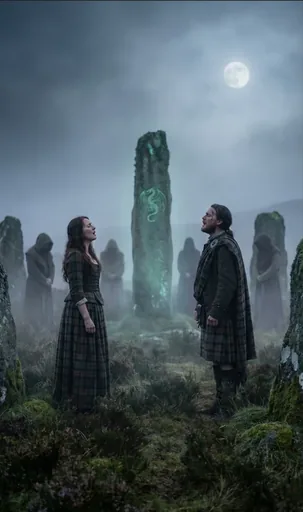
A dual-voice Highland keening: the woman carries ancestral grief, the man answers with quiet strength. No pipes, only breath and the raw echo of loss and resilience. Two voices mourning as one, under the eternal protection of the Green Dragon who never dies.
Gàidhlig
[Rann I — An Caoineadh Tòiseachaidh] A-cho-stad nan tonn, èisdibh rium, a chlanna nan creag, a shinnsearan mo chridhe. Tha an oidhch' trom os ar cionn, agus an gaoth ag èigneach nan sgeul fada. [Rann II — Call nan Gaisgeach] Tha sinn a' caoineadh Alasdair Mac Coinnich, a thuit le lann 'na dhòrn aig Cùil Lodair nam fuath. Bha e mar chreag air bruach an locha, agus mar sgàil a' dìon nam fear òga. Tha sinn a' caoineadh Eòghann mac Dhòmhnaill, a chaidh le guth tàmh ach le cridhe làidir. Bha e mar bhuaile nan coilltean, a' stiùireadh ar ceumannan mar mhodh na h-àirde. [Rann III — Call nan Seann-fhrithealaichean] Tha sinn a' caoineadh Màiri nic Raghnaill, a dh'fhàg an saoghal mar dhuilleag foghair. Thog i sgeul nan linntean oirnn, agus shìn i gliocas air ar n-uachdaranachd. Tha sinn a' caoineadh Seumas mac Eachainn, nach fhacas tuilleadh fo ghrèin na Beinne Bige. Bha e 'na sholas anns an dorchadas, agus 'na fhàidhe air an t-slighe uaine. [Rann IV — An Cruinneachadh] Cruinnichibh, a chlann an Dhragaín, fo sgàil nan clach is nan sìthichean. Leigibh leis a' ghaoth ur guthan a thogail, mar shrann nan daoine air chall. [Rann V — Neart an Tràghadh] Ged a thuit ar càirdean fo lìon an ùine, cha tuit ar neart, cha sgàin ar ceangal. Tha an Dragan Uaine os cionn ar cridheachan, agus e gar cumail mar dhealbh do-sgaraichte. [Crìoch — An Solas nach Dìth] Chan eil am bas ach mar chaoineadh na h-èilde, air a chruthachadh air creagan a' chuain. Oir chan bàsaich an Dragan Uaine, agus mar sin cha bàsaich ar creideamh. Tha sinn nar sliochd, agus esan nar dìon, agus èiridh sinn a-rithist leis an latha.
English
[Verse I — Opening Keening] Stop the waves, listen to me, children of the cliffs, ancestors of my heart. The night is heavy above us, and the wind forces the long stories to rise. [Verse II — The Fallen Warriors] We keen for Alasdair MacKenzie, who fell with a blade in his fist at Cùil Lodair of hatred. He was like a rock on the loch’s shore, a shadow protecting the young men. We keen for Eòghan MacDonald, who left with a quiet voice but a strong heart. He was like a fold in the woods, guiding our steps like the measure of the heights. [Verse III — The Departed Elders] We keen for Màiri NicRaghnaill, who left the world like an autumn leaf. She raised the stories of the ages upon us, and laid wisdom on our leadership. We keen for Seumas MacEachainn, who was not seen again under the sun of the Small Mountain. He was a light in the darkness, and a prophet on the green path. [Verse IV — The Gathering] Gather, children of the Dragon, under the shadow of stones and spirits. Let the wind lift your voices, like the shouts of those lost long ago. [Verse V — Strength in Loss] Though our friends have fallen under the net of time, our strength will not fall, our bond will not break. The Green Dragon is above our hearts, and keeps us as an unbroken form. [Ending — The Light That Does Not Die] Death is only like a deer’s cry, shaped upon the rocks of the sea. For the Green Dragon does not die, and so our faith shall not die. We are his lineage, and he is our protection, and we shall rise again with the day.
In the cycle
Intro / summary
The keening of the clan. The most intimate of the founding chants, where grief becomes memory, and memory becomes continuity. This is not performance. It is the bridge through which the dead remain inside the breath of the living.
What this composition is
This is the sacred lament of the cycle. In the ritual life of the clan, keening is not decorative mourning. It is a disciplined act of remembrance through voice. It keeps names from being lost and makes grief part of collective endurance.
Within the architecture of the saga, this is the chant in which the clan confronts mortality without fragmentation. It does not end the cycle. It deepens it.
What it represents
This composition represents memory through grief. The clan does not deny death, but neither does it accept death as erasure. In this vision, the voices of the dead enter wind, stone, and chant itself. To lament them is not weakness. It is a form of protection, because what is remembered remains within the living order of the clan.
This is one of the central sacred values of the lore.
Ritual frame
- Function
- funerary memory and ancestral continuity
- Ritual role
- keening of warriors, elders, and the dead of the clan
- Place
- stone circle, not publicly disclosed in the lore
- Element
- wind, breath, memory
- Dominant voice
- alternating male and female voices, sustained by vocal drone
- Atmosphere
- intimate, dark, restrained, metaphysical
- Cycle position
- C3
Symbolic meaning
The keening belongs fully to the Dragon’s voice-form. In the mythos, the most powerful manifestation of the Dragon is not visual but vocal: a vibration in wind, a response in stone, a continuity of breath across generations. This chant makes that concept audible. The dead are not represented as gone, but as translated into another form of presence.
Listening note
This piece requires stillness. It should not be approached as song in the modern sense, but as a ritual state. The alternation of voices matters: memory here is never singular, it is carried between bodies, across genders, across generations.
Text note
The text explicitly remembers named figures of the clan, including Seumas mac Eachainn and Róis nic Màrtainn, linking personal remembrance to collective continuity. The official ritual documentation also defines keening as the most sacred clan rite, performed without applause, without closure, and in silence after the final note.
Place in the saga
The invocation shelters. The march gathers. The oath binds. The keening remembers.
From here, the cycle can move outward into light, vision, warning, water, transmission, and, later, silence.