II · Introduction — Track 03
Mionnan Fhala an Dhragaín Uaine
The Blood-Oath of the Green Dragon
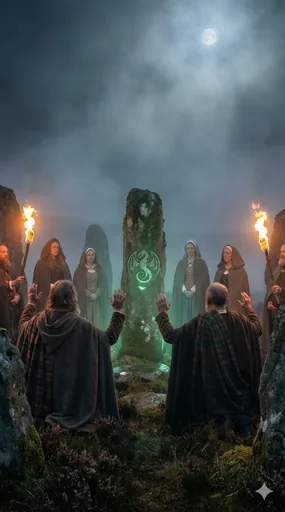
The blood oath, voiced by the united men of the clan with a distant female chorus echoing the ancestors. Their keening seals the vow to the eternal Green Dragon — the spirit of land, lineage, and unbroken faith.
Gàidhlig
[Rann I — Gairm nan Sìth] Éisdibh, a chàirdean an fhàsaich, éisdibh ri guth nan linn dorcha. Fo sgàil nan seann-chreagan, gairmidh sinn ainm an Dhragaín Uaine. [Rann II — An Fuil] Le fuil nan sinnsear air ar làmhan, le luaithre nan gaisgeach air an talamh, bidh ar cridheachan fosgailte, mar a bhios an gaoth mu thimcheall nan lochan. [Rann III — An Gealladh] Tha sinn a' mionnachadh an seo, ri aghaidh nan nàmh' is nan oidhche, gu seasamh mar chloich, agus gluasad mar sgàil na sìth. [Rann IV — Ceangal nan Dràgon] Oir tha an Dragan Uaine nar anail, nar fala, nar n-òrain, nar n-aisling. Troimhe sin 's tro ar ceumannan, bidh e gar cumail gus deireadh nan linn. [Mionn Crìochnachaidh] Mar sin, fo ghealach nan creagan, fo fhuaim nan tonn agus nan druma, mionnanaidh sinn le ar cridhe is ar fhuil: gun trèig sinn an Dragan Uaine, agus gun trèig e sinne gu bràth.
English
[Verse I — Call of the Spirits] Listen, friends of the wilderness, listen to the voice of the dark ages. Under the shadow of the ancient cliffs, we call the name of the Green Dragon. [Verse II — The Blood] With the blood of our ancestors on our hands, with the ashes of warriors on the ground, our hearts will be open, as the wind is around the lochs. [Verse III — The Vow] We swear here, before enemies and night alike, to stand like stone, and to move like the shadow of peace. [Verse IV — The Dragon-Bond] For the Green Dragon is in our breath, in our blood, in our songs, in our dreams. Through him and through our steps, he will keep us until the end of ages. [Final Oath] Thus, under the moon of the cliffs, under the sound of waves and drums, we swear with our heart and blood: that we will not abandon the Green Dragon, and he will not abandon us, forever.
In the cycle
Intro / summary
The oath of the clan. A ritual of continuity spoken beneath the Green Dragon’s shadow, where men, women, and the collective voice join into one form of allegiance, memory, and protection.
What this composition is
This chant is the formal act by which the clan binds itself. It is not an oath to domination or violence. It is an oath of continuity, mutual protection, and shared belonging. The chant gives voice to the law that the clan exists only as long as its bond is renewed.
In the structure of the cycle, this is the first moment of explicit declaration. What the march embodies physically, the oath now makes audible.
What it represents
This composition represents unity as vow. It is where lineage, memory, and future generations are held in a single act of speech. The ritual joins paternal blood, maternal blood, and unborn blood, creating continuity across time rather than only within the present.
This is why the oath stands at the centre of clan identity. It is not theatrical. It is constitutional.
Ritual frame
- Function
- fidelity, continuity, reciprocal protection
- Ritual role
- blood oath of the clan
- Place
- Jarlshof
- Element
- fire, oath, green-marked memory
- Dominant voice
- male chorus with female ancestral answering voice, resolved by the collective voice
- Atmosphere
- intense, solemn, binding
- Cycle position
- C2
Symbolic meaning
Here the Dragon shifts toward a form of lawful presence. The clan does not swear to the Dragon as to a deity. The lore is explicit: the oath is made not to the Dragon, but with the Dragon, as witness and living condition of the bond. The chant therefore embodies one of the central ethical principles of the saga, mutual protection sustained by memory.
Listening note
Hear this piece as a tightening of the circle. The emotional register is grave, but not mournful. It carries obligation, warmth, risk, and endurance all at once.
Text note
The canonical text invokes the blood of fathers, mothers, and children yet unborn, then resolves into the collective unity of the clan beneath the Dragon’s shadow. In the ritual documentation, this three-voice structure is one of the defining features of the oath rite.
Place in the saga
The march forms the body. The oath forms the bond. After the bond is spoken, memory can be faced.