II · Introduction — Track 02
Marc nan Dhragaín Uaine
March of the Green Dragon
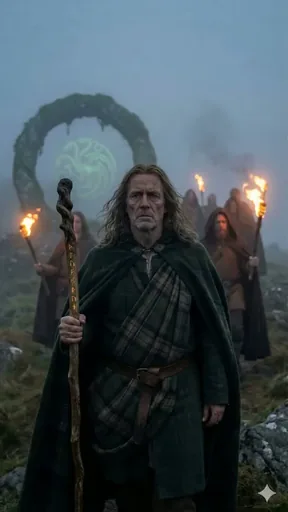
The clan walks as one beneath mist and stone, guided by the eternal Green Dragon — the spirit of land, lineage, and unbroken purpose.
Gàidhlig
[Rann I] Éirighibh, a chlanna nan creag, Éirighibh anns an fhàsaich fhuaire. Thigibh fo sgàil an Dhragaín Uaine, sgiath nan sluagh agus solas nan linntean. [Rann II] Cluinnear buille nan drumaibh domhain, cluinnear ceumannan nan daoine dìleas. Aig ceann na glinne, fon adhair ghruamaich, èiridh an t-seann chreutair ann an lasair uaine. [Rann III] Thug e neart do sheann-athraichean, thug e solas tro dhorchadas na h-oidhche. Thug e cridhe do'n fheadhainn a thuit roimhe, agus guth do'n dream a sheas na aghaidh. [Seist Mairseal] Seasaibh! Seasaibh! Fo sgéith an Dhragaín Uaine! Coisichibh gu mall fo lasair nan sìth. Dìonadh e sinn, agus sinn a' dèanamh urram dha. [Rann IV] Anns an loch, far a bheil fuaim nan linn, gluaiseas an sgàil uaine mar anail bheatha. Tha e gar gairm, mar a ghairm e roimhe, gu ceum na mairseil seo — ceum na seann chinneadh. [Seist Mairseal] Seasaibh! Seasaibh! Fo sgéith an Dhragaín Uaine! Coisichibh gu mall fo lasair nan sìth. Dìonadh e sinn, agus sinn a' dèanamh urram dha. [Crìoch] Éirigh, a Dhragaín nan lochan domhain, Éirigh agus coisich os ar cionn. Tha sinn nar clann, agus thusa nar gaisgeach. Mar sin bithidh e gu bràth.
English
[Verse I] Rise, children of the cliffs, rise in the cold wilderness. Come under the shadow of the Green Dragon, the shield of the people and the light of ages. [Verse II] Let the beats of the deep drums be heard, let the footsteps of the faithful be heard. At the head of the glen, under the gloomy sky, the ancient creature rises in green flame. [Verse III] He gave strength to our forefathers, he gave light through the darkness of night. He gave heart to those who fell before him, and a voice to those who stood against him. [March Chorus] Stand! Stand! Under the wings of the Green Dragon! Walk slowly under the flame of the spirits. Let him protect us, as we honor him. [Verse IV] In the loch, where the sound of ages dwells, the green shadow moves like the breath of life. He calls us now, as he called before, to this march — the march of the old clan. [March Chorus] (repeat) Stand! Stand! Under the wings of the Green Dragon! Walk slowly under the flame of the spirits. Let him protect us, as we honor him. [Ending] Rise, O Dragon of the deep lochs. Rise and walk above us. We are your children, and you are our warrior. Thus it shall be forever.
In the cycle
Intro / summary
The first formal chant of the cycle. A march, but not a military one. This is the movement by which the clan gathers itself, walking beneath wind and mist as one body, one rhythm, one memory.
What this composition is
This is the chant of collective rising. The march is not about conquest, display, or aggression. It is a ceremonial act of alignment. The clan moves together to renew its bond with land, ancestors, and one another.
In the logic of the saga, this is the first true communal gesture. If the invocation opens the threshold, the march is the first answer to that opening.
What it represents
This composition represents cohesion through movement. The clan becomes visible to itself by walking together. The body learns what the voice will later swear. Before the oath can be spoken, the people must become one pace.
That is why this piece matters so much in the architecture of the work: it is not simply about beginning the cycle, it is about forming the communal body that the rest of the cycle depends on.
Ritual frame
- Function
- gathering and renewal
- Ritual role
- annual procession of the clan
- Place
- misted Highland paths, oriented toward the sacred stone
- Element
- earth and wind
- Dominant voice
- male-led, with distant answering presence
- Atmosphere
- slow, grounded, processional
- Cycle position
- C1
Symbolic meaning
The march belongs to the Dragon’s shadow-form, where presence is carried by terrain, weather, and disciplined human movement. The Dragon is not shown. It is implied by the fact that the clan walks under an order larger than individual will.
This is one of the key ritual forms of the clan tradition. In the ritual archive, the march is described as a rite of gathering and reconstitution, marked by silence, slow pace, and communal orientation toward the sacred centre.
Listening note
This is not a song to consume quickly. It works best when heard as a paced act, almost as if each phrase were a step. Its strength lies in repetition, steadiness, and forward weight.
Text note
The chant calls the “children of the cliffs” to rise and move beneath the Green Dragon’s shadow. In the canonical song file, its function is defined as union, protection, and collective determination rather than warfare.
Place in the saga
After the threshold comes movement. After movement comes the vow.