III · Chant — Track 18
Cuimhne Gun Ghuth
Memory Without Voice
Memory remains when voices are gone. A melody remembered rather than heard, carrying time forward as the old world quietly gives way to what comes next.
Gàidhlig
(Pìos ionnsramaideach. Chan eil faclan ann.)
English
(Instrumental piece. There are no words.)
In the cycle
Intro / summary
A final state of presence without utterance. Here the saga nears its completion. What remains is memory, but no longer carried by singing, speaking, or calling. The work persists as trace, contour, and withheld form.
What this composition is
This composition is the third movement of the Form of Silence and one of the most delicate points in the entire saga. It is not a song in the ordinary sense. The canonical documents define it as memory in pure state, with melody only suggested, never actually sung. Presence remains, but voice has withdrawn.
This is a crucial distinction. The saga does not end by forgetting itself. It ends by ceasing to require audible utterance in order to remain real.
What it represents
This composition represents persistence beyond articulation. The clan’s memory is no longer dependent on declared speech, and the Dragon’s presence no longer depends on any perceptible sign. What survives is not emptiness, but held continuity stripped of expressive necessity.
That makes this composition one of the highest acts of discipline in the whole cycle. It resists the temptation to turn final memory into a final statement. It leaves memory where it belongs, present, but no longer seeking to prove itself.
Ritual frame
- Function
- pure remembrance, non-vocal continuity, retained presence
- Ritual role
- pre-final state of memory after speech has ended
- Place
- nowhere and everywhere the cycle has already passed, because place now survives as residue rather than scene
- Element
- time
- Dominant voice
- none, though traces of melodic contour may remain implied
- Atmosphere
- faint, withheld, lucid, nearly immaterial
- Cycle position
- C17
Symbolic meaning
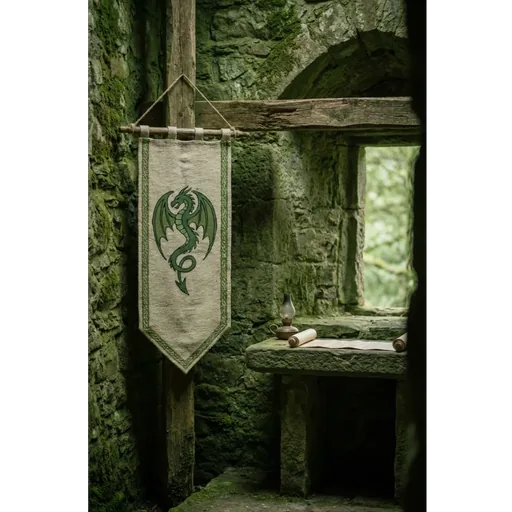
This composition belongs to the Dragon only as remembered presence without active sign. The visual law of the project is relevant here: the Dragon may be remembered, never shown; inscribed, never theatrically evoked; and by the final stages must recede almost entirely from explicit form.
So Memory without Voice becomes the point where the saga is still present but no longer representational. It is neither disappearance nor statement. It is retention without claim.
Listening note
This piece should be approached almost as an after-image. Listen not for a sung line, but for the pressure of one that might have been there and no longer needs to be.
Text note
The final canonical notes define Cuimhne Gun Ghuth as memory carried without voice, with melody suggested but never fully sounded. This is one of the purest expressions of the project’s late discipline of subtraction and restraint.
Place in the saga
Beneath the Ground withdraws the work into depth. Memory without Voice preserves what remains without sounding it.
Only one gesture is left: the end of the breath.