III · Chant — Track 15
Ceum nan Clach
The Steps of Stones
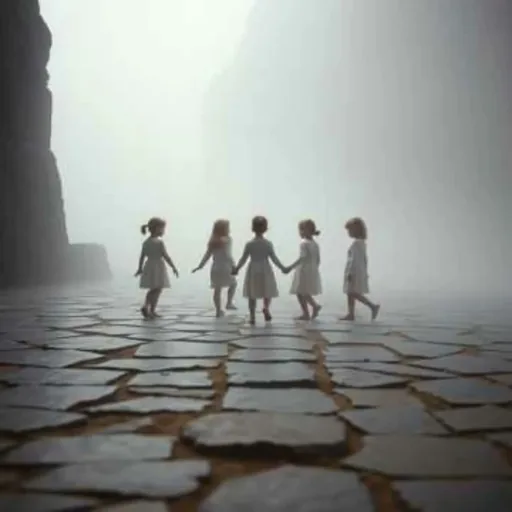
Children of the Clan walk and sing without knowing why. Stone underfoot, breath of the land beneath them. Continuity does not explain itself — it moves.
Gàidhlig
[Rann 1] Ceum air clach. Clach fo chois. Chan eil guth ann. [Rann 2] Gluaisidh sinn. Mar a ghluais iad fhèin. Gun cheist. [Rann 3] Gaoth air ar druim. An talamh fo ar bonn. Is leòr sin dhuinn. [Rann 4] Chan eil ainm ann. Chan eil sgeul ann. Chan eil ach ceum ann. [Cor] Ceum nan clach. Ceum gun fhuaim. Ceum fhathast. [Rann 5] A' chlann a' gluasad. Gun fhios carson. Ach a' gluasad fhèin. [Cor] Ceum nan clach. Fo anail na talmhainn. Tha sinn ann fhathast. Ceum air clach. Clach fo chois. Chan eil guth ann.
English
[Verse 1] Step on stone. Stone under foot. There is no voice. [Verse 2] We will move. As they themselves moved. Without question. [Verse 3] Wind at our back. The earth under our sole. That is enough for us. [Verse 4] There is no name. There is no story. There is only a step. [Chorus] Step of the stones. Soundless step. Step still. [Verse 5] The children are moving. Not knowing why. But moving themselves. [Chorus] Step of the stones. Under the breath of the earth. We are here still. Step on stone. Stone under foot. There is no voice.
In the cycle
Intro / summary
A chant of generational passage and embodied continuity. After waiting and dark confession, the saga does not offer purification or triumph. It offers something quieter and more durable: the fact that the young still walk. The clan continues because movement passes into other feet.
What this composition is
This composition is the fourth movement of the final arc’s Form of Earth. It marks the moment when continuity becomes physical again, not through oath or dramatic declaration, but through the simple act of passage from one generation to the next. The canonical documents describe it as a chant of children or young voices, with a walking cadence and no explanatory symbolism. That restraint is essential.
What matters here is not innocence in a sentimental sense, but transfer. The elders do not explain the whole burden. The young do not fully understand what they inherit. Yet they move. And the movement is enough to keep the cycle from breaking.
What it represents
This composition represents continuity without proclamation. The clan does not survive by announcing that it has survived. It survives because the pattern of life, memory, and step remains incarnated in those who come after.
Its position in the cycle is exact. After the severity of The Dark Stories, the work does not seek moral cleansing. It turns instead toward the more modest and more truthful fact that even damaged inheritance can continue to be carried, if it is carried honestly and without theatricality.
Ritual frame
- Function
- generational passage, embodied continuity, simple transmission
- Ritual role
- rite of the stepping generation
- Place
- stone paths, shore-edges, or ground marked by repeated passage rather than fixed monument
- Element
- movement
- Dominant voice
- young voices or light timbres with plain cadence
- Atmosphere
- spare, walking, lucid, quietly durable
- Cycle position
- C14
Symbolic meaning
This composition belongs to the Dragon’s movement into continuity as gesture rather than manifestation. The Dragon is not presented here as shadow, light, or voice in any emphatic form. Presence persists in the fact that the pattern goes on. A step answers another step. Stone holds the imprint of repeated passage.
That is why the chant is so important. It refuses the temptation to explain inheritance too much. The meaning is not delivered in abstract form. It is carried in rhythm, in pace, in the body’s acceptance of what came before.
Listening note
This piece should be heard like measured walking, neither burdenless nor dramatic. Its force lies in plainness. The cadence matters more than ornament, because continuity here is embodied before it is understood.
Text note
The final project documents define Ceum nan Clach as a chant of generational movement, with young or light voices, simple structure, and walking rhythm. The sense must not be overexplained. The rite works because it lets continuity appear in action rather than declaration.
Place in the saga
The Dark Stories expose what cannot be idealised. The Step of Stones shows that life continues anyway, and must do so without illusion.
From here, the saga crosses into the Form of Silence, where composition itself begins to withdraw.