III · Chant — Track 14
Na Sgeulachdan Dubha
The Dark Stories
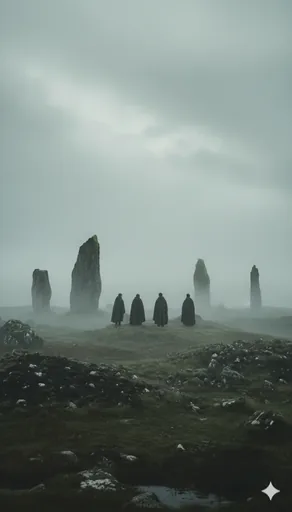
'Na Sgeulachdan Dubha' exposes what was left unsaid. Voices fracture, silence weighs, and the Dhragaìn does not answer. This chant does not resolve — it interrupts.
Gàidhlig
[Rann 1 — Guth Fir] Tha sgàil nar measg. Chan eil i ùr. Chan eil i air ainmeachadh. Tha i fo na faclan, fo na ceuman, fo na làmhan nach do ghluais. [Rann 2 — Cor Fhir] Cha do labhair sinn uile, ged a bha sinn nar seasamh còmhla. [Guth Fir (aonaranach)] Dh'fhan cuid de na faclan far nach robh solas. [Cor Fhir] Bha an ceum ro throm— [Guth Fir (aonaranach)] —agus chaidh e seachad gun fhuaim. [Rann 3 — Cor Fhir] Bha sàmhchair ann far an robh feum air guth. [Guth Fir (aonaranach)] Bha làmh air a cumail air ais, chan ann le neart, ach le dìth. [Cor Fhir] Dh'fhuirich sinn. Chan eil sinn cinnteach carson. [Rann 4 — Cor Fhir (iomlan)] Bha cuideam os ar cionn, gun ainm, gun chruth. Cha do bhris e. Cha do thuit e. Ach bha e ann, mar chreig nach gluais. [Rann 5 — Guth Fir (aonaranach)] Cha tàinig an Dhragaìn. Cha do fhreagair e. [Cor Fhir] Cha robh comharra ann, cha robh solas ann. Dh'fhuirich e sàmhach, mar an talamh fhèin. [Rann Deireannach — Guth Fir (aonaranach)] Dh'fhan an sgeul— (briseadh, gun chrìoch)
English
[Verse 1 — Male Voice] There is a shadow among us. It is not new. It is not named. It lies beneath the words, beneath the steps, beneath the hands that did not move. [Verse 2 — Male Chorus] Not all of us spoke, though we stood together. [Male Voice] Some words remained where there was no light. [Male Chorus] The step was too heavy— [Male Voice] —and it passed without sound. [Verse 3 — Male Chorus] There was silence where a voice was needed. [Male Voice] A hand was held back, not by force, but by lack. [Male Chorus] We remained. We are not certain why. [Verse 4 — Male Chorus (full)] There was weight above us, without name, without form. It did not break. It did not fall. But it was there, like a rock that does not move. [Verse 5 — Male Voice] The Dragon did not come. It did not answer. [Male Chorus] There was no sign, there was no light. It remained silent, like the earth itself. [Final Verse — Male Voice] The story remained— (interruption, no ending)
In the cycle
Intro / summary
A chant of shadow, fault, and unadorned confession. Here the saga enters one of its most severe regions. The clan no longer waits for an answer from beyond itself. It turns inward and faces what in its own history remains unresolved, unclean, or unredeemed.
What this composition is
This composition is the third movement of the final arc and one of the sternest structural acts in the entire work. It is the chant in which the clan exposes its errors, fractures, omissions, and inherited darkness without turning them into spectacle or heroic suffering. The Dragon does not absolve. The chant does not console.
This matters because the saga, for all its ritual dignity and ancestral gravity, cannot remain ethically serious if it speaks only of beauty, endurance, and protection. The Dark Stories is the place where continuity must confront complicity, silence, and internal failure.
What it represents
This composition represents confession without resolution. The clan is not purified by merely naming its shadows. Nor is it destroyed by them. Instead, it is asked to bear truthful memory without turning away.
That is why this composition stands exactly here. After waiting in non-response, the work does not move toward redemption. It moves toward truth. The clan must look at what has persisted not only nobly, but wrongly. The final arc would be false without this passage.
Ritual frame
- Function
- exposure of fault, collective confession, shadowed remembrance
- Ritual role
- rite of dark memory and moral reckoning
- Place
- not fixed to one site, but spiritually aligned with enclosed ground, irregular weather, and unstable footing
- Element
- shadow
- Dominant voice
- broken or irregular voice, resisting smooth continuity
- Atmosphere
- uneasy, fractured, raw, unheroic
- Cycle position
- C13
Symbolic meaning
This composition belongs to the Dragon in its most difficult mode: not protector, not light, not answer, but measure of truth before which false continuity fails. The Dragon does not punish in a theatrical sense. It does not intervene to expose guilt. Rather, within its field of presence, what is false cannot be ritualised into beauty without cost.
So the chant does something rare and necessary. It refuses to aestheticise darkness. The stories are dark not because they are gothic, but because they contain division, error, and unhealed inheritance.
Listening note
This piece should be heard without expecting symmetry. Irregular rhythm, unstable phrasing, and broken line are part of its ethical shape. It should feel difficult to inhabit, because it names what the clan cannot comfortably integrate.
Text note
The final documents describe Na Sgeulachdan Dubha as the chant of confession, with broken voice, irregular rhythm, and no heroism. The Dragon explicitly “does not absolve.” This is one of the clearest signals in the whole saga that maturity requires exposure, not mythic self-flattery.
Place in the saga
The Waiting taught endurance without response. The Dark Stories demand truth without relief.
From here, the cycle moves toward generational passage, where survival continues not because all has been healed, but because the young still walk.